
Study visit to Warsaw and Krakow
08 11 2025
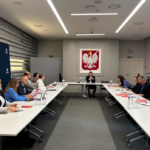
The third study visit took place on November 7-8, 2025, as part of the research project “The impact of the shape of the political system on the quality of functioning of state institutions took place in Warsaw. Polish and Ukrainian experiences and perspectives”. Over the course of two days, the research team met with representatives of the Supreme Audit Office and the Office of the Commissioner for Human Rights, among others.
The visit began in Warsaw with a meeting at the Supreme Audit Office, where the participants were welcomed by the President of the Supreme Audit Office, Mr. Mariusz Haładyj. He spoke about the good cooperation between the audit institutions of Poland and Ukraine, as well as Poland’s use of Ukraine’s digital experience (the Prozorro system) in developing a digital public procurement system in Poland.
The meeting provided a comprehensive overview of the body’s activities. The legal acts governing the operation of the Supreme Audit Office were discussed: the Constitution of the Republic of Poland (Articles 202–207), the 1994 Act on the Supreme Audit Office (NIK), and the orders of the Speaker of the Sejm and the President of the Supreme Audit Office. It was emphasized that the Supreme Audit Office (NIK) is the supreme state audit body. Although it reports to the Sejm and is accountable to it for its activities, it operates independently and independently of other state bodies.
Ms. Anna Libera, acting deputy director of the Department of Legal Affairs and Audit Jurisprudence, and Ms. Justyna Goszcz, legal advisor in the department, presented the scope of audits conducted by the Supreme Audit Office (NIK) concerning government administration, the National Bank of Poland, state organizational units, local governments, and entities using public funds. Audit criteria were also discussed: legality, cost-effectiveness, expediency, and reliability. The organizational structure of the body and the audit process, initiated by the Sejm or on the NIK’s own initiative, were presented, culminating in the preparation of a post-audit statement and de lege ferenda conclusions (proposed changes to the law). It was also noted that the NIK cooperates with law enforcement agencies, prosecutors, and other audit bodies. The presentation concluded with highlighting the main challenges facing the body, including overly general regulations regarding audits of private entities using public funds, lengthy procedures, insufficient use of digital audit capabilities, and the potential of using artificial intelligence (AI) in audit analyses. Polish and Ukrainian members of the research team actively participated in the discussion during the meeting. The Ukrainian researchers were particularly interested in the Whistleblower Protection Act, which implements an EU directive that entered into force in Poland in 2024. Participants inquired about the obligations of public institutions to protect individuals reporting violations of the law and about the practical aspects of implementing the new regulations.
The Ukrainian researchers were also intrigued by the method of appointing members of the Supreme Audit Office (NIK). During the discussion, they presented the system in force in Ukraine, where candidates are selected through an open competition and then appointed to their positions. In Poland, however, members of the Supreme Audit Office (NIK) are appointed directly, which is a significant difference compared to the Ukrainian system.
The visit to the Supreme Audit Office allowed participants to deepen their knowledge of public auditing and its standards in Poland. The meeting also fostered an exchange of experiences between Polish and Ukrainian researchers on the organization and operational principles of audit institutions.
The second meeting in Warsaw took place at the Office of the Commissioner for Human Rights. The Office of the Commissioner for Human Rights was represented by Mr. Maciek Kruk, Director of the Team for Presidential Affairs and International Cooperation. He presented the scope of activities and the constitutional framework of the Commissioner for Human Rights, as defined by the Constitution of the Republic of Poland (Articles 208–212) and the Act on the Commissioner for Human Rights. The Commissioner for Human Rights is an independent and sovereign body, appointed by the Sejm with the consent of the Senate for a five-year term. The necessity of cooperation between both chambers of parliament in selecting a candidate was emphasized, which requires political compromise.
Participants learned about the organizational structure of the Office of the Commissioner for Human Rights – it currently employs approximately 350 staff. In 2024, the Office received approximately 78,000 complaints, demonstrating the institution’s importance in Poland’s human rights protection system. In addition to its headquarters in Warsaw, the Ombudsman also has regional offices in individual voivodeships.
The procedure for accepting complaints was also presented: they can be filed by all citizens, including foreigners residing in Poland. Complaints can be submitted in person, by phone, or by email, and electronic means are currently the most common form. Many cases involve Ukrainian citizens: the Commissioner for Human Rights maintains ongoing cooperation with its Ukrainian counterpart, which includes, for example, joint visits to refugee centers.
Most cases reviewed by the Commissioner for Human Rights involve providing information and clarifications, but the Commissioner can also intervene in civil, administrative, and criminal matters (including filing appeals with the Prosecutor General or filing cassation appeals). Therefore, the Commissioner serves as a “last resort” for citizens who believe their rights have been violated and existing legal remedies have proven ineffective.
The importance of the Commissioner for Human Rights’ cooperation with other state bodies was emphasized, as they are obligated to respond to the Commissioner’s complaints within 30 days. In practice, institutions usually respond, but there are no sanctions for exceeding this deadline. It was pointed out that dialogue between the Ombudsman and the public administration is of key importance for the effective protection of citizens’ rights.
The meeting also discussed current systemic problems, including the overuse of pre-trial detention and its excessive duration. The discussion section touched on complaints concerning Ukrainian citizens and compared them to other cases, demonstrating that they do not differ substantially in nature and subject matter. Reference was also made to statistical data showing the dynamics of the number of cases submitted to the Commissioner for Human Rights before Poland’s accession to the EU, during membership, and currently.
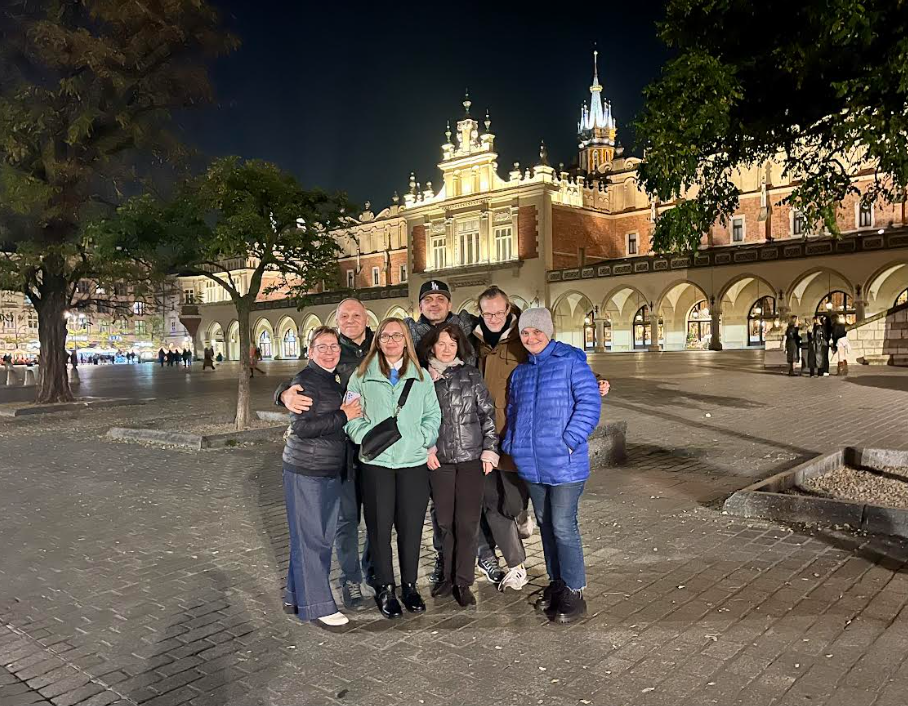
Visit to Krakow
The second day of the study visit began with a meeting with Mr. Bogusław Sonik, an experienced politician and former Member of the Polish Parliament and the European Parliament. The meeting was a discussion-based event and focused on the process of democratization in Poland, the role of local governments, and the experience of European integration – topics also relevant to contemporary Ukraine.
In the first part of the meeting, Mr. Sonik discussed the process of democratic transformation in Poland, highlighting the so-called “shortcomings.” The “democratic delay” of the 1970s, when Polish society grew increasingly desirous of living within democratic structures, including the European Community. A turning point in national consciousness was the election of Cardinal Karol Wojtyła as Pope John Paul II, which strengthened the sense of legitimacy of the aspirations for freedom and gave Poles strong spiritual support.
The next stage was the Solidarity movement, which sparked interest in Poland across Europe and accelerated the process of political change. Mr. Sonik emphasized that during this period, the French émigré elites became convinced that it was necessary to begin adapting Poland to future European integration. After the fall of the USSR and the reunification of Germany, Poland was finally able to actively engage in the process of democratic transformation.
The meeting also discussed the process of establishing and reviving local governments in Poland, a key element in adapting to European governance standards. The creation of 16 large voivodeships (voivodeships) was aimed at increasing administrative efficiency and strengthening the potential of the regions. The speaker noted that this could be a valuable experience for Ukraine, pointing out that larger local government units can foster stronger partnerships and regional cooperation.
The meeting continued with a discussion of the division of responsibilities between the voivodeship and local government administrations: the voivode is responsible for, among other things, crisis management, security, and emergency response, while the voivodeship marshal and the regional assemblies are responsible for infrastructure, transport, cultural institutions, railways, and EU funds. It was noted that in Poland there is a high level of identification of citizens with local authorities, which is the foundation of civil society.
The discussion also touched on the specific constitutional conditions and political system of Poland after 1989. After the fall of communism, President Lech Wałęsa advocated for strong presidential power, but the drafting of the Constitution led to a compromise: a system with elements of the chancellor model was created, in which the president retained veto power and the role of commander-in-chief of the armed forces, but real executive power was entrusted to the government headed by the prime minister. The period after 1993 was also mentioned, when the post-communists returned to power, and public disillusionment with Balcerowicz’s reforms led to constitutional debates and a search for social balance.
During the discussion, Ukrainian researchers questioned the origins and conditions of the political system adopted in Poland and the role of local governments. Concerns about decentralization in Ukraine, particularly at the district level, were raised, especially due to the risk of separatist movements. The speaker emphasized that the effectiveness of local government reforms requires ensuring financial independence and a clear division of responsibilities between districts and voivodeships.
The next highlight of the visit to Krakow was a meeting with Rafał Komarewicz, Member of the Sejm (lower house of parliament) and former Chairman of the Krakow City Council. The meeting focused on comparing the principles of local government and the national parliament, as well as the differences in the way power is exercised at the local and national levels.
The MP pointed out that local government is a structure much closer to citizens, and the decisions it makes have a direct impact on the daily lives of residents. In local government, agreements are more common between different political groups, as the overarching goal is to implement specific projects, such as those concerning schools, transport, infrastructure, or local initiatives.
However, in the Sejm (lower house of parliament), the speaker emphasized, a completely different dynamic operates – political infighting dominates, which is why bills prepared by the opposition rarely gain support, even if they have substantive justification. The MP pointed out that this practice often hinders the implementation of initiatives that benefit citizens, citing the example of the tourist tax law, which, despite support from various political groups, was not implemented.
The discussion continued with a discussion of the structure of government in Poland and the relationship between central and local governments. Mr. Komarewicz pointed out that tasks and costs are often delegated from the central level to local governments without ensuring adequate funding. He emphasized the crucial importance of establishing clear rules for the distribution of public revenues and ensuring stable funding for local governments.
Part of the discussion also focused on the Lobbying Act. The MP noted that the official register of lobbyists lists only a few active entities, which does not reflect the true scale of the phenomenon. Many MPs avoid direct contact with lobbyists, fearing accusations of a lack of transparency, although, as he emphasized, the role of a MP is to gather information from various sources and consult on draft legislation with experts and stakeholders.
The meeting concluded with a discussion of the politicization of state-owned companies. The speaker pointed out that a change of government often means a change of management staff in state-owned companies, which leads to discontinuity and limits the professionalization of management. He emphasized that a key challenge for the Polish political system is ensuring that these positions are filled by individuals with appropriate qualifications, not by party affiliations. The discussion also touched on the transparency of the legislative process, the relationship between the government and local governments, and the ethical aspects of exercising public office.
In summary, the study visit to Warsaw and Krakow was an important element of the cooperation program between Polish and Ukrainian researchers, devoted to analyzing and exchanging experiences on the functioning of democratic institutions, the protection of human rights, and the role of local governments in the European integration process. It enabled a better understanding of how democratic institutions operate in practice, the lawmaking process, and the crucial role of social dialogue in public life. The meetings demonstrated that both Poland and Ukraine face similar challenges related to the transparency and efficiency of administration, as well as building citizens’ trust in public institutions.